4 Steps to Becoming a Deliberate Creator of Your Life

The Secret to Becoming a Deliberate Creator of Your Life
Most people are creating their lives every single day without realizing it.
They are reacting to circumstances, repeating the same thoughts, telling the same stories, expecting the same outcomes, and then wondering why life keeps looking familiar.
That is what I call creating by default.
Becoming a deliberate creator means becoming more conscious of what you are choosing, what you are focusing on, how you are feeling, and what actions you are taking.
In the teachings of Abraham-Hicks and in books like The Secret by Rhonda Byrne, the Law of Attraction is centered around the idea that your thoughts, emotions, expectations, and focus influence your experience.
Whether you look at this spiritually, metaphysically, or simply as a way of becoming more intentional with your mindset, the goal is the same:
- Stop living on autopilot.
- Start creating with purpose.
Here are four steps that can help.
1. Intention — Decide What You Actually Want
The first step is getting clear.
What do you actually want?
- Not what you are afraid will happen.
- Not what you think is realistic.
- Not what other people expect from you.
What do you want?
Many times, contrast helps us discover the answer.
- A difficult relationship may show you what kind of relationship you really desire.
- Financial struggle may help you recognize that what you truly want is security, freedom, flexibility, or abundance.
- An unfulfilling job may reveal that you want creativity, independence, peace, purpose, or more control over your time.
Instead of staying focused on what is wrong, use the contrast to clarify what you want instead.
Ask yourself:
If I did not have to worry about how it would happen, what would I choose?
This is where tools like visualization, scripting, affirmations, vision boards, prayer, intention work, and candle work can be helpful.
But remember this:
The tool is not the power.
The tool helps you focus your mind and intention.
The real question is whether you are clear about what you are choosing.
2. Attention — What Are You Feeding With Your Focus?
Once you know what you want, the next question is:
What are you giving your attention to?
Your desire?
Or the opposite of your desire?
This is where many people get stuck.
- They say they want abundance, but spend most of the day talking about lack.
- They say they want love, but constantly repeat how no one can be trusted.
- They say they want success, but continuously tell themselves they are too old, too late, too tired, or too unlucky.
Repeated thoughts can become patterns.
Patterns can become beliefs.
Beliefs can shape expectations.
And expectations often influence the choices we make.
It may look something like this:
Thought → Repetition → Pattern → Belief → Expectation → Behavior
That is why it is so important to pay attention to what you repeatedly think and say.
For example:
Instead of constantly saying,
“I never have enough money,”
you might begin shifting toward,
“I am becoming more open to new ways of creating financial stability.”
That does not mean pretending.
It means redirecting.
Abraham-Hicks often refers to this as a pivot: moving your attention from what you do not want toward what you would prefer.
Ask yourself:
What story am I repeating that describes the life I no longer want?
Then begin changing the story.

3. Alignment — How Are You Feeling About What You Want?
This is where the emotional part comes in.
You may have asked.
You may have visualized.
You may have written the goal down.
You may have done the ritual.
But if you spend every day asking,
“Where is it?”
you may still be mentally anchored in the experience of not having it.
Alignment is about noticing whether your thoughts and emotions are supporting your intention or fighting against it.
Ask yourself:
Who would I be if I truly believed this was unfolding for me?
- Would you be calmer?
- More confident?
- More patient?
- More grateful?
- More expectant?
- Would you make different choices?
This does not mean forcing yourself to feel joyful when you are not.
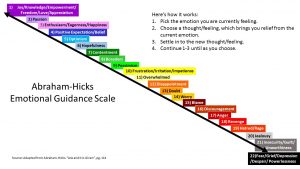
One of the things I appreciate about the Abraham-Hicks emotional guidance concept is the idea of reaching for a better-feeling thought rather than trying to jump from fear straight into happiness.
For example:
“I am never going to have enough money.”
can become:
“Things have worked out for me before.”
Then:
“I believe things will improve.”
Then:
“I am a money magnet.”
That shift matters.
Alignment does not have to mean perfection.
Sometimes it simply means moving toward relief.
4. Inspired Action — Move When the Opportunity Appears
Deliberate creation does not mean sitting still and waiting for life to happen.
You still have to move.
But there is a difference between forced action and inspired action.
Forced action sounds like:
- “I have to make this happen.”
- “I am running out of time.”
- “If I do not do this right now, I am going to lose everything.”
That kind of action often comes from panic, fear, or desperation.
Inspired action feels different.
It may sound like:
- “I keep thinking I should call this person.”
- “I feel like I should apply for that position.”
- “I keep getting the idea to start this project.”
- “Something is telling me to make this move.”
When the idea keeps coming, pay attention.
Take the step.
Follow the opening.
- Make the call.
- Send the email.
- Apply.
- Create.
- Move.
Deliberate creators are not passive.
- They notice opportunities.
- They respond.
- They experiment.
- They adjust.
- They keep moving in the direction of what they have chosen.
One of my favorite ways to say it is:
The Universe can knock but are you going to open the door?.
The 4-Step Formula
If you remember nothing else, remember this:
Intention → Attention → Alignment → Inspired Action
- Intention: What do I want?
- Attention: What am I focusing on?
- Alignment: What am I feeling and expecting?
- Inspired Action: What am I being prompted to do?
Intention chooses the destination.
Attention feeds the direction.
Alignment prepares you to receive.
Inspired action moves you toward it.
Becoming a deliberate creator does not mean controlling every detail of life.
It means becoming more conscious of the part you are playing in your own experience.
You begin noticing your thoughts.
You become clearer about your desires.
You become more aware of your emotional patterns.
And you become willing to take action when the path opens.
That is when you stop creating by default and begin creating on purpose.
And you can begin right now.